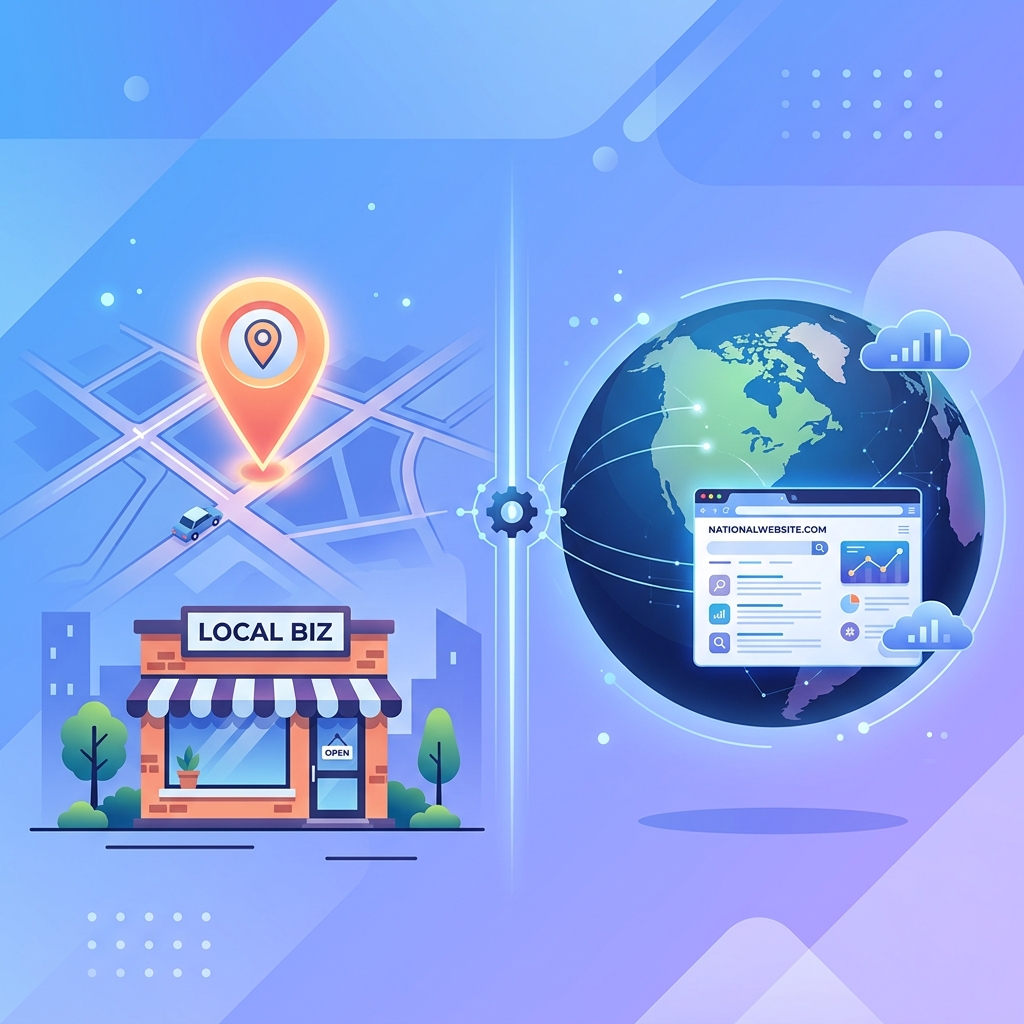
SEO is not a monolithic discipline. The strategies that help a national e-commerce brand rank on Google are fundamentally different from those that help a local plumber appear in the Map Pack. Understanding these differences is essential for choosing the right approach for your business.
In this guide, we'll break down the key differences between local SEO and national SEO across every major dimension: ranking factors, keyword strategy, content approach, link building, and measurement.
The Core Difference
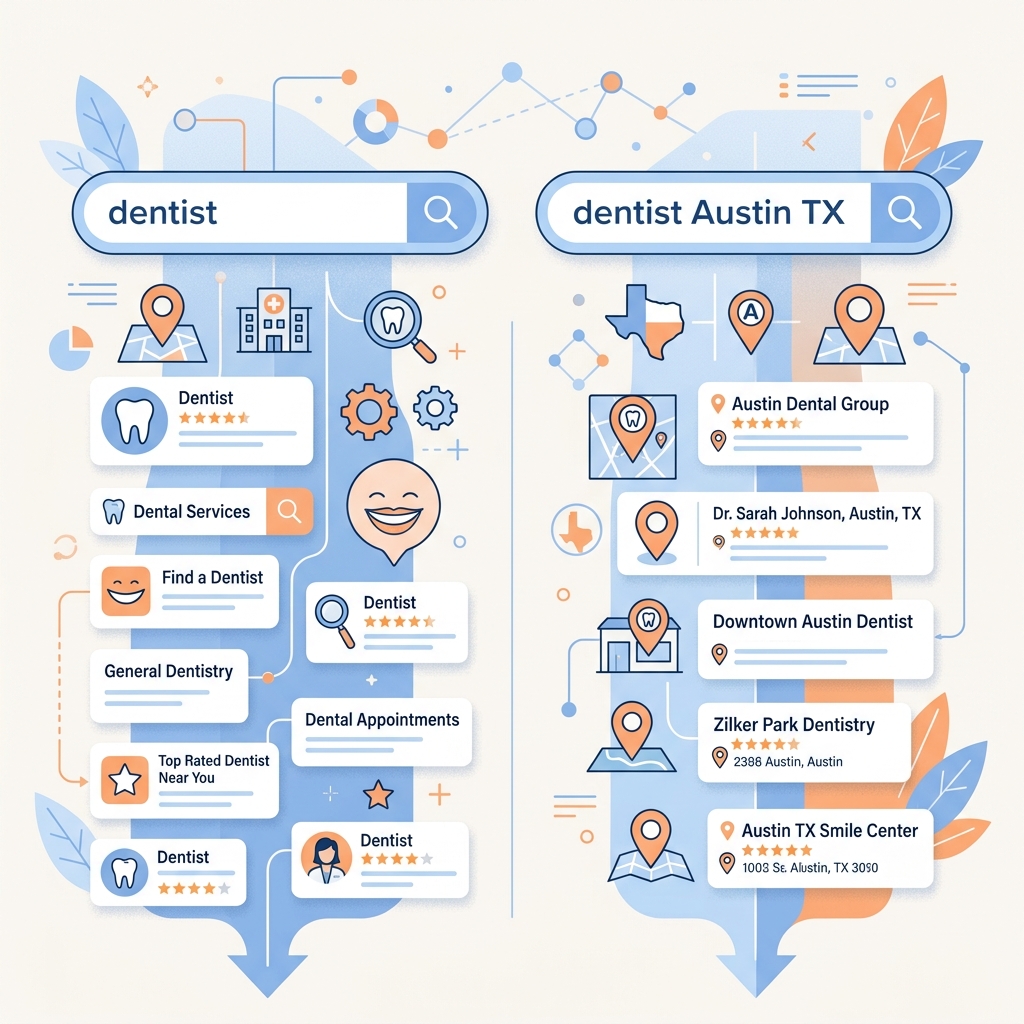
National SEO focuses on ranking a website for broad keywords that don't have geographic intent. The goal is visibility across an entire country or globally. Examples: "best project management software," "how to invest in stocks," "women's running shoes."
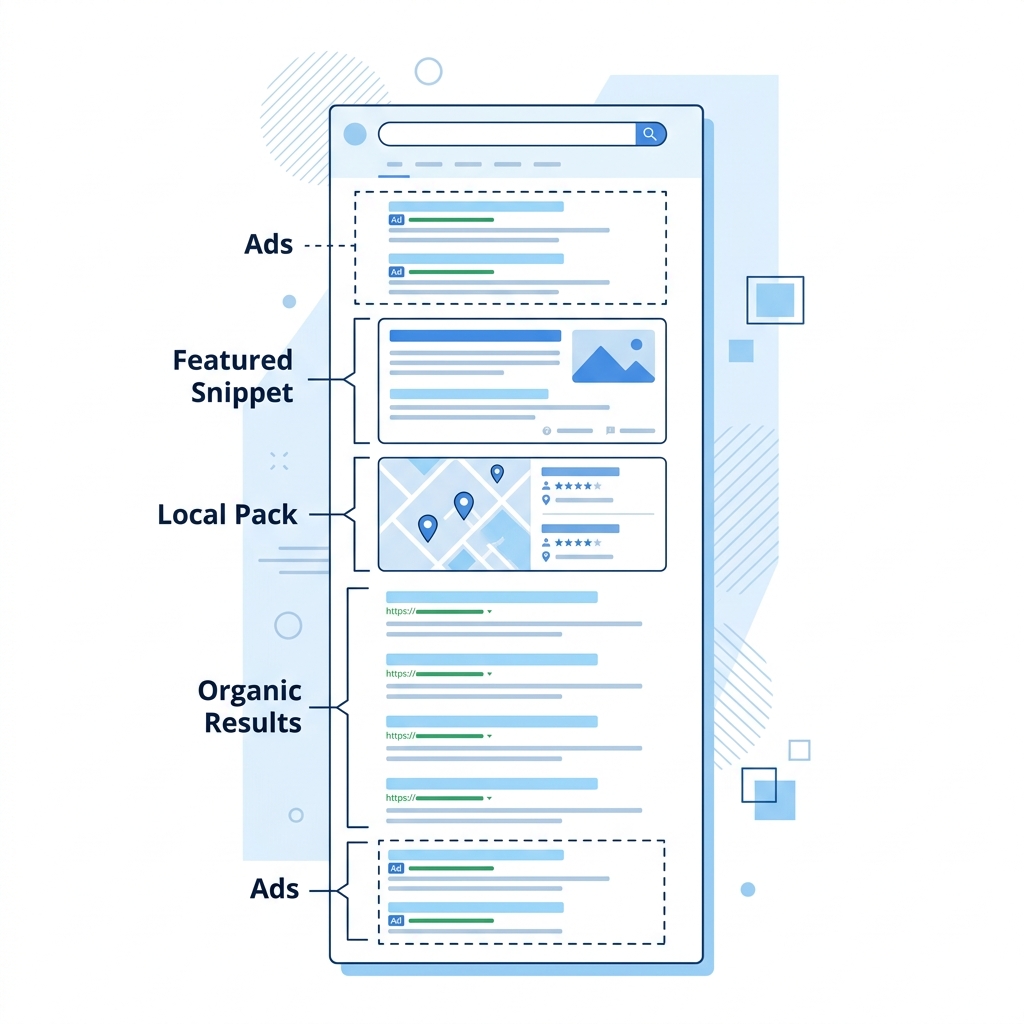
Local SEO focuses on ranking a business for location-specific searches, particularly in Google's Local Pack (Map Pack). The goal is visibility to users in a specific geographic area. Examples: "plumber near me," "dentist in Portland," "best pizza Chicago."
The algorithms that power these two types of results are different. Google's organic algorithm and its local algorithm share some factors but have distinct ranking signals.
Ranking Factors Comparison
National SEO Ranking Factors
- Backlink profile — The quantity and quality of websites linking to you
- Content quality and depth — Comprehensive, authoritative content that satisfies search intent
- Technical SEO — Site speed, mobile responsiveness, crawlability, structured data
- Domain authority — Overall trust and authority of your domain
- User engagement — Click-through rates, time on page, bounce rates
Local SEO Ranking Factors
- Google Business Profile — Completeness, category accuracy, photos, posts
- Proximity — Physical distance between the searcher and your business
- Reviews — Quantity, quality, recency, and response rate
- NAP consistency — Identical Name, Address, Phone across all directories
- Local citations — Mentions on relevant local and industry directories
- On-page local signals — City names in title tags, local content, LocalBusiness schema
Notice that several local factors (proximity, GBP, reviews, citations) have no equivalent in national SEO. Meanwhile, backlinks—the dominant factor in national SEO—play a supporting but secondary role in local rankings.
Keyword Research Differences
National Keywords
- Focus on informational and transactional intent
- Target high-volume, competitive terms
- Long-tail variations for content marketing
- Example: "best CRM software for small business" (50,000 monthly searches)
Local Keywords
- Focus on implicit and explicit local intent
- Include geographic modifiers (city names, neighborhoods, zip codes)
- Target "near me" variations
- Prioritize the Local Pack trigger keywords
- Example: "CRM consultant Chicago" (200 monthly searches, but extremely high intent)
Local keyword research requires a different mindset. A keyword with 200 monthly searches might seem insignificant from a national perspective, but for a local business, those 200 searches represent high-intent prospects actively looking for a service in their area.
Content Strategy Differences
National Content Strategy
- Pillar pages and content clusters
- Comprehensive guides, thought leadership, and research
- Content designed to earn backlinks and social shares
- Topic authority across broad subject areas
- Blog posts targeting thousands of informational keywords
Local Content Strategy
- Location-specific service pages (one per city or neighborhood)
- Local case studies and customer success stories
- Community involvement content (sponsorships, local events)
- Locally relevant blog posts (industry news affecting your city)
- FAQ pages addressing location-specific questions
The biggest mistake local businesses make is adopting a national content strategy. Writing a 3,000-word guide on "How to Choose a Plumber" won't help you rank in the Denver Local Pack. But creating a page titled "Emergency Plumbing Services in Denver, CO" with locally relevant content, embedded Google Maps, and Denver-specific testimonials will.
Link Building Differences
National Link Building
- Guest posting on industry publications
- Creating linkable assets (studies, infographics, tools)
- Digital PR and journalist outreach
- Broken link building
- Skyscraper technique
Local Link Building
- Sponsoring local events, charities, and sports teams
- Getting featured in local news outlets and community blogs
- Chamber of Commerce and local business association memberships
- Partnering with complementary local businesses for reciprocal links
- Supporting local schools or community organizations
Local links from locally relevant websites carry disproportionate weight in the local algorithm. A single link from your city's newspaper is often more valuable than ten links from generic national blogs.
Measurement and KPIs
National SEO KPIs
- Organic traffic volume
- Keyword ranking positions
- Domain authority / domain rating
- Organic conversion rate
- Backlink acquisition rate
Local SEO KPIs
- Local Pack ranking position
- Google Business Profile actions (calls, directions, website clicks)
- Review count and average rating
- Local organic traffic
- Citation accuracy score
- "Discovery" vs "Direct" search ratio in GBP Insights
Can You Do Both?
Yes, but it requires separate strategies. A national law firm with offices in 15 cities needs both:
- A national content strategy to build domain authority for broad legal topics
- Individual local SEO strategies for each office location, with unique GBP listings, localized content, and local link building
The mistake is trying to use one approach for both goals. National content doesn't help local rankings, and local optimization doesn't build national authority.
Further Reading
- Understand the local algorithm's core factors: How Google's Local Search Algorithm Works in 2026
- Ensure your citations are consistent: What are NAP Citations and Why Do They Matter?
- Learn the fundamentals of SERP anatomy: What is a SERP? A Complete Guide
Key Takeaways
- Local and national SEO use different algorithms with different ranking factors
- Proximity, GBP optimization, and reviews dominate local rankings
- Backlinks and content depth dominate national rankings
- Local keyword research targets lower volume but higher intent searches
- Local link building focuses on community-relevant, geographically-specific sources
- Businesses operating at both levels need separate, coordinated strategies
Digital marketer specializing in Local SEO and PPC. James has spent years helping businesses and agencies understand what their customers actually see on Google — and built QueryFrom to make that process faster for everyone.